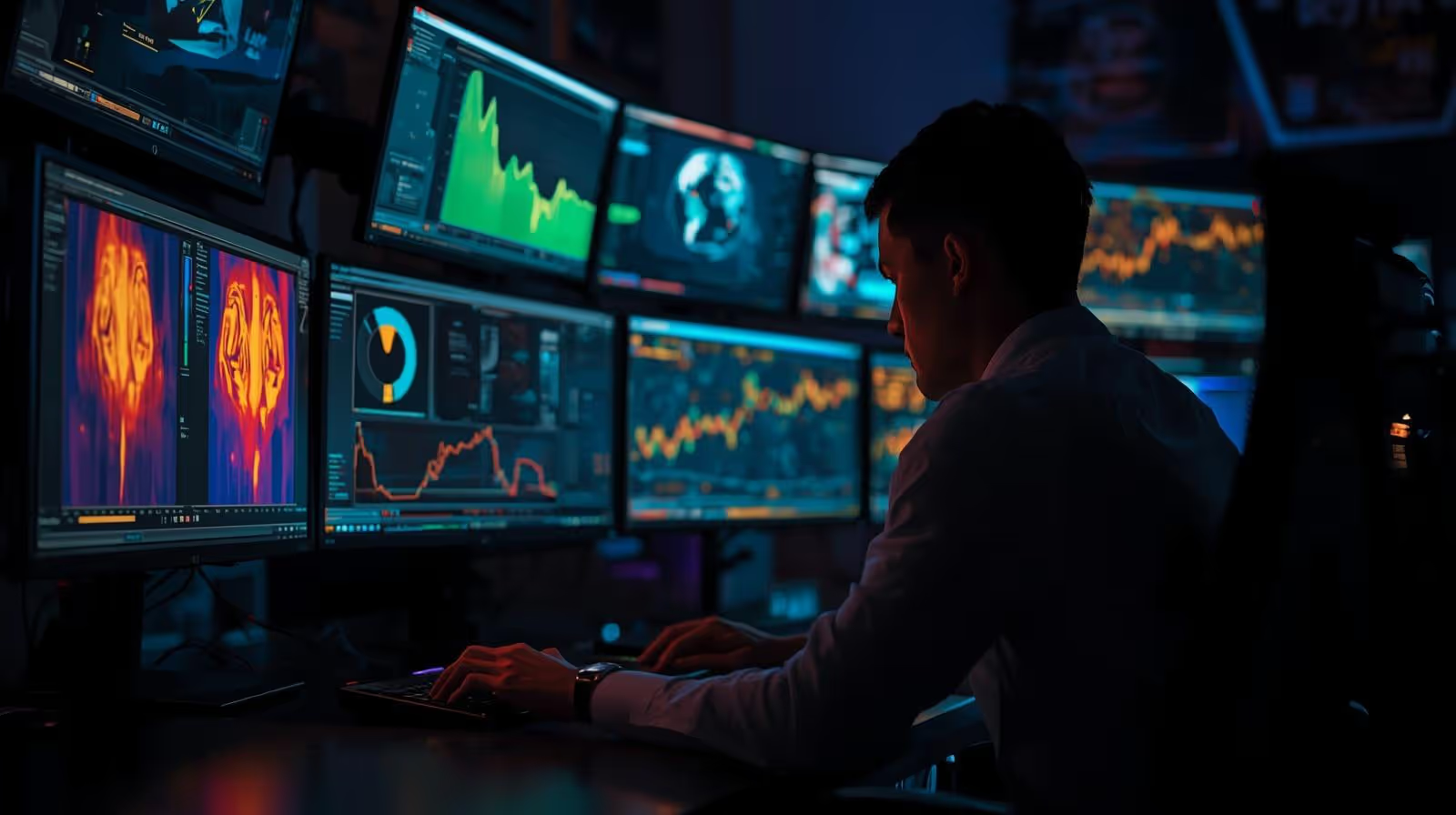
Live esports in February 2026 looks bigger on camera than it did even a few years ago, but the real contest happens off-screen. Promoters, teams, and cities are competing on infrastructure, because nothing kills a marquee match faster than shaky connectivity, bad sightlines, or a production setup that can't take a hit.
That's why "esports arena" now needs a clearer definition. A dedicated esports arena is purpose-built, or purpose-renodeled, around competitive play, broadcast control, player facilities, and high-capacity internet, not just seats and a stage. In contrast, a converted theater or sports arena can host esports well, yet it usually relies on temporary networking, rented production gear, and shared back-of-house space. Pop-up setups go further, they're fast and flexible, but they live or die by load-in time, vendor coordination, and redundancy plans.
The money follows that split. Arlington shows what a focused conversion can look like, with the Esports Stadium Arlington operating at scale after a reported $10 million transformation and a long-term lease model. Philadelphia's Fusion Arena plan points to the other side of the risk curve, a $50 million esports-first build that never materialized as designed, later shifting toward a smaller multi-use approach.
So what actually counts as "good enough" for Tier 1 events, and what's worth paying for? This piece breaks down the investment bands, the cost drivers that quietly dominate budgets (network redundancy, power, rigging, staffing, downtime), and simple ROI checks operators can use without getting trapped in hype. Along the way, it flags why projects people still talk about, including the much-rumored Sunderland 2026 idea where public details remain thin, can succeed or stall based on the same fundamentals.
An esports arena isn't just a place where people watch games. It's closer to a TV studio that also sells tickets. The priorities flip compared to a regular stadium, because most fans watch the match on a screen, not on a field. Meanwhile, it goes far beyond a gaming lounge, because the goal isn't public play stations and casual events, it's broadcast-grade competition with repeatable show quality.
Think of three venues built around three different promises:
That difference shows up in the floor plan, the network, and the production stack.
A regular stadium can bolt on a stage, roll in screens, and bring in a broadcast truck. An esports arena usually bakes those needs into the building, because tournaments have a rhythm that repeats all day. Players arrive, warm up, compete, reset, and repeat. The crew rehearses segments, swaps match layouts, cuts highlights, and manages sponsor moments on schedule.
Most esports-first venues end up with a familiar set of zones:
Sunderland's National Gaming and Esports Arena plan, set near the National Esports Performance Campus, has highlighted content and editing studios as part of the venue concept. That detail signals a studio-first mindset, where the building supports creation and broadcast as a daily function, not a special add-on when a big tournament comes to town.
If the back-of-house looks like a small broadcast campus, you're probably looking at an esports arena. If it looks like a typical event venue with a temporary control setup, you're closer to a conversion.
Crowd flow matters too, because esports fans move differently. People leave their seats to watch from a concourse screen, meet creators, or catch a replay angle. As a result, arenas that plan wide circulation paths and "pause pockets" (where fans can stop without blocking traffic) tend to feel calmer even when they're full.
Esports infrastructure starts with a simple question: when a player clicks, how fast does the game respond, and does it respond the same way every time? That's where latency and packet loss come in.
A stadium can survive a brief Wi-Fi wobble. An esports match often can't, because competitive play depends on stability. When the network drops, you don't just lose a moment, you risk the integrity of the result.
That's why serious venues invest in the unglamorous parts:
Dedicated fiber and business-grade routing. You want enough capacity for broadcast, ops, and staff tools, with headroom. You also want routing that stays predictable under load.
Redundancy across connections. A backup line that shares the same trench, the same provider, or the same building entry point is not a real backup. Operators plan diverse paths so a single cut doesn't take out the show.
Separate networks for competition and guests. The competition environment should run isolated from public traffic. Guest Wi-Fi is important, but it should never be able to degrade the match network.
High-density Wi-Fi design that matches reality. Arenas don't fail because Wi-Fi is "bad." They fail because too many devices hit too few access points, with poor channel planning, weak backhaul, or blocked antenna placement.
Backup power that covers more than lights. You need clean power for network gear, production, and critical PCs. Short dips can crash systems, corrupt recordings, or force match restarts.
A runbook for outages. When something breaks, the team should know who decides what, how to switch to backups, and what gets communicated to teams, refs, and fans. The goal is speed and consistency, not heroics.
From an ROI standpoint, uptime is a revenue protector. Downtime can trigger refunds, extended labor, and schedule overruns. Sponsors may demand make-goods if promised segments don't run. Worst of all, reputational damage can raise the cost of the next booking, because organizers remember which venues felt risky.
A practical way to think about it is this: you're not buying "faster internet." You're buying predictable outcomes under pressure.
People often fixate on giant screens because they're visible. The smarter view is that screens, lighting, and audio form a single "show layer" that supports both the room and the stream.
In a stadium, the field is the star and the big screen fills gaps. In esports, the screen is the game, so display choices affect everything: how long fans stay engaged, how well cameras capture reactions, and how easy it is to keep energy up between rounds.
A strong esports arena typically prioritizes:
LED walls and immersive backdrops. Bright, high-refresh LED reduces flicker on camera and stays readable from a wide range of seats. Backdrops also create a consistent visual identity, which helps sponsors and makes highlight clips look polished.
Lighting designed for faces and screens. Players, casters, and crowd shots need flattering, consistent light. At the same time, you can't wash out the main display or create glare lines that ruin camera angles.
Professional-grade audio and controlled acoustics. Clear announcements, tight music hits, and intelligible commentary matter in person. Noise control also matters, because echoes blur speech and tire out the room. Good acoustics make the event feel more expensive than it is.
Camera-ready sightlines and rigging points. An esports arena should assume cameras will live in more places than you'd expect. You need positions for wide shots, player reactions, crowd angles, and roaming content creators, all without blocking views.
Fast changeovers between matches. Tournaments run on momentum. If your team can reset the stage, update branding, and roll the next intro quickly, you keep fans in their seats and you protect the broadcast schedule.
These decisions are not decoration. They're operational tools. Better sightlines reduce complaints and seat-hopping. Better audio reduces confusion and improves safety messaging. Faster changeovers cut overtime and let you sell tighter event schedules.
Every modern esports arena serves two crowds at once. One crowd buys tickets and shows up early. The other arrives through Twitch, YouTube, or co-streams, and they might outnumber the room by a mile. If you satisfy only one group, you leave money on the table.
That hybrid reality changes how venues plan:
Production becomes part of the building. You need stable camera positions, reliable cabling paths, comms, and space for crews to work without blocking circulation. Even smaller venues benefit from permanent or semi-permanent production infrastructure, because it lowers setup time and reduces failure points.
Flexible camera placements matter more than fancy add-ons. A few well-chosen positions, with clean sightlines and safe rigging, beat a complicated plan that slows down load-in.
The in-room experience still needs its own logic. Fans want big, readable screens, strong audio, and moments that feel live. That includes walkouts, crowd cams, and between-match segments that aren't just "dead time."
VR and AR can layer on top of this, for example by offering virtual viewing angles, shared watch spaces, or interactive overlays. Still, those features only work when the baseline is solid. If the stream stutters or the audio mix is muddy, no headset feature saves the day.
Hybrid-first design is really about consistency. The arena crowd should feel like they're inside the broadcast, while the online audience should feel the room's energy. When that loop works, esports stops feeling like a niche event in a rented hall and starts feeling like a repeatable, bookable product.
Costs for esports venues swing wildly because "venue" can mean anything from a locked practice suite to a broadcast-capable arena with premium seating, a control room, and year-round programming. The biggest driver is not the gaming PCs. It's the building work that makes events repeatable: power, cooling, rigging, acoustics, life safety, and network redundancy.
If you want a simple way to sanity-check a budget, ask one question early: are you building a place to play, a place to watch, or a place to produce? The more your business depends on ticketed shows and streaming quality, the more your costs start to look like a small TV studio that also handles crowds.
A dedicated esports venue doesn't just "host tournaments." It carries the risk of live broadcast deadlines, sponsor deliverables, and crowd safety in the same room.
Most investors group esports venue spend into a few practical tiers. The differences come down to permanence (fixed installs vs rentals), capacity (seats and egress), and production expectations (local stream vs international broadcast).
Training rooms ($100K to $500K)
This tier is closer to a high-end team facility or a strong local competition hub. If you're asking, "Can we open quickly and prove demand?", this is usually the starting point.
You're typically paying for:
Budgets jump fast when you add permanent lighting, sound reinforcement, and a built-in control room. Still, this tier can work well if your revenue plan centers on memberships, bootcamps, and small events.
Mid-sized arenas ($500K to $2M)
This is the "serious local operator" band. You can host regular ticketed events, qualifiers, and sponsor activations, but you still make careful choices about what you buy versus rent.
What changes here is intent. You're no longer optimizing for cheapest setup. Instead, you're optimizing for repeatability, because every hour you save on load-in and troubleshooting is money back in your pocket.
Common upgrades include:
If you're planning to host third-party events, this is also where organizers start asking harder questions about backstage space, loading access, and tech staffing.
Large-scale venues ($2M+)
Once you move above $2M, you're generally building for scale, broadcast consistency, and brand perception. In other words, you're buying down operational risk.
A conversion can land here, and a new build often starts here, because the building systems become a bigger slice of the budget:
Real-world anchors help frame what "large-scale" looks like:
The takeaway is simple: the "arena" number investors quote may be only part of the spend, especially when the venue is tied to a larger site strategy.
First-time owners often budget for PCs, consoles, and screens, then get blindsided by everything that makes the room stable, safe, and camera-ready. The trick is to separate fixed equipment (installed into the building) from movable equipment (can be rented, swapped, or upgraded without construction).
Fixed equipment tends to drive the hard checks:
Movable equipment is where people overbuy too early:
Lighting and broadcast gear deserve special attention because they punch above their weight in perceived quality. Fans forgive average chairs. They don't forgive a dim stage, bad color on camera, or audio that turns commentary into mush.
Recurring costs are the real gravity. Even a well-built venue can bleed if the monthly burn is misread:
Streaming and production systems also aren't a set-and-forget purchase. Viewer expectations rise, sponsors demand cleaner integrations, and leagues tighten technical standards. If your plan assumes you'll buy production once and coast for a decade, the budget will break.
If you can't afford ongoing staff and refresh cycles, you can't afford the arena, even if construction is paid for.
Choosing between a new build and a conversion is less about pride and more about risk. A conversion can get you open sooner and cut upfront spending, but it can also lock in constraints that cost you later.
Conversions (warehouse, cinema, or a slice of a sports complex) often win on speed and capex. You inherit a shell, utilities, and sometimes parking and transit access. Esports Stadium Arlington is a strong example of the conversion path, transforming convention center space with a reported $10 million budget and a fast timeline.
That said, retrofits can hide expensive surprises:
New builds cost more, but they let you design for the show you intend to run. You can plan proper loading, create quiet production rooms, and integrate cable routes and power where they belong. You also control the fan experience from entry to exit, which matters when ticket sales are part of the model.
Timeline risk is where the decision gets sharp. Conversions can reveal issues only after walls open up. New builds can get stuck in permitting, supply delays, or scope creep when stakeholders keep adding "just one more" feature. Either way, schedule slips hit ROI directly because revenue doesn't start until doors open, while interest, rent, and payroll can.
If you want a practical filter, treat the venue like a kitchen. A conversion is remodeling a restaurant in an old building. It's often cheaper, and it can be amazing, but you might discover the plumbing is in the wrong place. A new build costs more, yet it lets you place every gas line, drain, and prep station with intent.
Esports venues rarely get funded from a single source because the benefits land in different places. Teams want performance and content capability. Operators want booking flexibility and margin. Cities want tourism, jobs, and press. Universities want student recruitment and workforce training. As a result, funding structures tend to stack.
Private funding is most common when the venue is tied to a team brand, a venue operator, or a real estate strategy. The planned Fusion Arena in Philadelphia shows how that looks in practice. Comcast Spectacor backed the project as part of a bigger South Philadelphia complex plan, with Populous attached for design, before the concept later shifted and the esports-only arena was abandoned as designed.
Private deals usually come with clear control. The trade is simple: investors expect performance, and they don't wait long for proof. If bookings, sponsorships, or content revenue lag, budgets tighten fast.
Public funding and public support show up when officials can justify spillover value, like hotel nights, local hiring, or skills training. In the US, this often flows through universities and civic projects rather than standalone pro arenas. These arrangements come with more oversight, more procurement rules, and more pressure to show measurable outcomes.
Mixed deals combine capital from developers with incentives from government. Incentives can include:
Accountability matters here because esports headlines can outpace results. If the venue promises jobs and visitation, decision makers will want hard reporting. Clear KPIs help, for example event-days booked, average attendance, local vendor spend, and student participation if a university is involved.
Internationally, public involvement can also show up in proposal-stage projects. In the Philippines, IMAHINASYON appears in research as a thesis proposal for an esports arena and related institute in Sta. Rosa, Laguna, with references to public bodies like GDAP or the Games and Amusement Board as potential funders, along with a large proposed budget in pesos. Whether or not a concept gets built, it reflects a common pattern: governments show interest when esports connects to education, jobs, and tourism, not only entertainment.
The funding lesson is blunt: the more parties you invite to pay, the more parties you must satisfy. That's not a bad thing, but it changes how you plan, how you report, and how you define success.
Arenas that rely only on marquee tournaments end up with a familiar problem: long stretches of fixed costs and short bursts of income. Rent (or debt service), payroll, bandwidth, utilities, insurance, and equipment refresh cycles don't pause just because the calendar is quiet.
So the strongest esports arena business models look less like "concert venues" and more like "event plus studio plus club." Big event days still bring attention and big checks, but operators stay healthy by stacking revenue streams that run on ordinary weeks. The goal is simple: keep the building earning when the lights are not pointed at a trophy.
Event days are still the cleanest way to create a revenue spike because you can monetize the same fan more than once. A ticket gets them in the door, then the arena earns again through upgrades and in-building spend.
Most operators plan event-day economics around a few practical benchmarks:
The economics feel basic because they are basic. Still, execution is where arenas win or lose. If points of sale are too few, lines kill per-cap spend. If the merch booth sits in a dead corner, you miss impulse buys. If VIP check-in is sloppy, your highest-paying customers start the night annoyed.
A simple way to think about it is this: ticket revenue pays for the show, while per-cap spend pays for the building. When you plan staffing, inventory, and queue flow around that idea, you protect margin without raising prices.
The easiest money to lose on event day is the money you already had in the room, a hungry fan who gives up because the line looks brutal.
For many esports events, sponsorships and advertising drive a large share of total revenue across the industry. That reality shows up in arenas too, especially between majors, because sponsor money can be contracted year-round while ticket revenue stays seasonal.
Arenas sell sponsorship inventory the way modern sports and live entertainment do, as a mix of physical space, broadcast exposure, and content rights. The practical packages often include:
The hard part is measurement. Sponsors don't pay for vibes, they pay for proof. That pushes arenas to offer credible reporting, such as:
Clean production matters more than most operators admit. If your audio mix is messy, sponsor reads get missed. If the stream drops frames, promised impressions don't land. If lighting breaks skin tones, creators won't post clips, and your sponsor loses the afterlife of the event.
That's why sponsorship ROI ties directly to infrastructure and uptime. The arena is selling reliability as much as it sells space. In a good deal, everyone wins: the sponsor gets measurable reach, the audience gets better experiences, and the arena gets cash flow that doesn't depend on selling out every weekend.
Between major events, the calendar becomes the product. A building that sits dark bleeds money, while a building with consistent programming can smooth revenue, keep staff sharp, and build local habit.
The strongest year-round programming mixes competitive, social, and commercial uses. Common examples include:
This mix helps because consistent scheduling reduces risk. Staff efficiency improves when your ops team runs the same opening checklist every Thursday, not once every six weeks. Vendors get predictable order patterns. Even your network monitoring becomes easier because you learn what "normal" looks like on a busy night.
It also fits the audience you're trying to keep. Esports crowds skew younger, with a heavy concentration under 35, and that group often prefers repeatable social rituals. Give them a "Tuesday locals" or a "Sunday watch party," and you're not waiting for a once-a-year mega-event to remind people you exist.
The calendar strategy also protects sponsorship. Brands like consistency. A year-long series with smaller weekly moments can outperform one expensive weekend, especially when the arena can prove attendance, engagement, and content output.
Memberships are the arena's answer to the slow season. When done well, they turn irregular visitors into regulars, and that reliable income helps cover fixed costs when the event calendar gets thin.
Most esports arena memberships stay simple because fans understand simple. You pay a monthly or term fee, and you get access plus perks. Real-world examples in the market include memberships priced in the tens of dollars per month, and university arenas that sell semester or annual passes for students and community members.
The perks that tend to work best are the ones that save members time or money:
Recurring revenue is powerful, but it comes with a sharp risk: churn. If programming gets stale, people cancel fast. That's why memberships can't be a lazy add-on. They need a content plan, even a modest one, like rotating game nights, short seasonal leagues, and monthly member tournaments.
A good operator treats membership like a promise. Keep the venue clean, keep the PCs stable, keep the schedule consistent, and members will forgive a smaller space. Break that promise twice, and the subscription line starts shrinking right when you need it most.
ROI for an esports arena gets messy fast because the "product" changes by event, season, and game title. A packed finals weekend can hide three slow weeks. A sponsor deck can look great right up to the first renewal conversation. So the goal is not a perfect forecast. It's a model that tells you what must be true for payback to happen, then checks those assumptions every month.
Treat ROI like a flight plan. You can't control the weather, but you can control fuel, routes, and emergency options. If your numbers only work in perfect conditions, you don't have an ROI plan, you have a wish.
Capex is the money you spend to build and equip the venue. Think construction, seating, LED, rigging, network buildout, production gear, and the first wave of PCs. It's the "buy it once" spending, even though some of it will need refresh later.
Opex is what it costs to run the place. Rent or debt service, payroll, internet circuits, utilities, insurance, software, security, cleaning, repairs, and ongoing marketing. Opex shows up whether you host an event or not.
To keep yourself honest, start with a simple break-even model that separates fixed monthly costs from variable event costs.
Then calculate your minimum event count:
This is where people fool themselves. They plug in best-case attendance, full sponsor sell-through, and "average" bar spend, then declare victory. Instead, run a stress test with two scenarios:
If the business only breaks even in the best-case scenario, fix the plan before you pour concrete. Reduce fixed costs, raise per-event margin, or design the venue so it can book non-esports events without heavy rework.
A break-even plan isn't a spreadsheet exercise, it's a booking requirement. If your model needs 18 strong events a month, your calendar just told you the truth.
Once you open, ROI becomes a monthly discipline. Don't drown in vanity stats. Focus on a small set of numbers that explain whether the venue can pay for itself without constant "hero" weekends.
Utilization rate (nights booked)
Utilization answers a simple question: how often is the building earning? Track booked event nights as a share of available nights, then separate:
A venue can feel busy and still miss ROI if too many nights don't generate margin.
Contribution margin per event (the real unit economics)
Gross ticket sales don't matter if labor, rentals, and overtime eat the day. Contribution margin shows what each event contributes to covering fixed costs.
Watch for margin killers that repeat:
If contribution margin swings wildly, standardize your event packages and charge for complexity.
Average spend per attendee (in-building yield)
This is the mix of tickets plus on-site spend (food, beverage, merch, upgrades). Related venue data points often cite $25 to $50 per attendee in smaller venue settings, and $50 to $100 per attendee in larger arena-style environments when VIP and merch hit. Those ranges are not guarantees, so treat them as guardrails, then validate against your own POS data.
To improve this metric, fix friction first. Long lines and slow POS systems are silent revenue leaks. So are merch booths that can't handle halftime-style rushes between matches.
Sponsor renewal rate (proof that you delivered value)
Sales can look strong in year one because partners want to "try esports." Renewal is where reality shows up. Track renewals by sponsor tier and category, then tie them to what you can control:
A single sold-out weekend won't save you if renewals slide.
Labor share of revenue (the swing factor owners ignore)
Labor is often the fastest way to destroy margin because it spikes with chaos. In adjacent venue models like esports bars and event spaces, operators often try to keep total labor under about 35% of revenue. Your target will vary, but the point stands: scheduling and staffing plans matter as much as ticket pricing.
A tight staffing plan starts before show day:
Put simply, a venue with good systems can beat a nicer venue with sloppy ops.
Most esports arena ROI failures aren't caused by one big mistake. They come from three quiet problems that stack.
Overbuilding for local demand
Big capacity looks good in renderings. It also raises fixed costs and staffing needs. If your market can reliably fill 300 seats for community tournaments, building for 2,500 seats creates a gap you must cover with major events that may never land.
A safer approach is to build around what you can book weekly, then add scalable elements:
The room should feel intentional at half capacity, not empty.
Underbooking because you chased only prestige events
Relying on one publisher, one league partner, or one annual tournament is a fragile plan. Contracts change. Games fall out of favor. A touring circuit can skip your city for logistics reasons that have nothing to do with your venue.
Owners protect ROI by building a calendar that survives a lost anchor booking:
Your best defense is a schedule that doesn't depend on one phone call.
Tech that ages fast, plus the refresh cycle you didn't budget
Esports venues run on hardware. Hardware gets old. PCs, cameras, lenses, switchers, comms systems, and LED processors all follow upgrade cycles. Even if gear still works, it can stop meeting organizer standards.
That creates two ROI problems:
Owners often budget capex like it ends at opening day. In reality, you need a refresh reserve. If you don't set it aside, the gear ages, then bookings get harder, then revenue falls, then upgrades become even harder to fund.
Streaming views are not arena profit
Online viewership can build brand value, but it doesn't automatically pay your rent. Remote viewers don't buy tickets, don't stand in merch lines, and don't purchase concessions. If you want streaming to support ROI, tie it to cash you can trace, like sponsor deals with clear deliverables, or merch that converts through trackable offers.
Treat streaming like marketing unless you can show direct dollars tied to the broadcast.
Some esports arena projects don't live or die on ticket profit alone. Cities and public partners often care more about tourism, jobs, and district momentum. That changes how ROI gets measured, and it changes what "success" looks like.
Sunderland is a clean example of the city-strategy approach. The Sunderland National Gaming and Esports Arena is set to open in early 2026 (Q1) next to the National Esports Performance Campus, which opened in 2023. Public details emphasize function over flash: a 15,000-square-foot facility with a 200-seat theater, a 17-meter LED screen, plus broadcast and editing studios and hospitality space. The pitch is also tied to wider regeneration near the Stadium of Light and the Riverside Sunderland plan, with a stated focus on skilled jobs and drawing international visitors.
In that context, payback can look different:
For owners working with public stakeholders, the discipline shifts from "did we profit on the event?" to "did local spend show up, and can we prove it?" That means measuring things private operators sometimes skip:
This doesn't excuse weak operations. It simply means the arena can be justified as part of a larger plan, not as a stand-alone profit machine. If you're in that category, write it down early, then build reporting around it, because "economic impact" only counts when it's documented and believable.
The infrastructure race in esports is no longer about who can pack the most seats. It's about who can deliver repeatable broadcast quality, protect uptime, and book the building enough nights to justify the fixed costs. In 2026, the winners look less like traditional sports venues and more like compact production hubs that also sell tickets.
You can see the direction clearly in three places: studio-first civic builds (like Sunderland), university-backed facilities that grow talent pipelines, and optional VR and AR layers that expand reach without rebuilding the room.
The next wave of esports arenas won't win on size alone. They'll win on reliability, production speed, and how often they can turn the lights on for paid bookings.
Sunderland's National Gaming and Esports Arena plan is a clean signal that the market is maturing. The published details emphasize production, not just spectators: a 15,000 sq ft venue with a 200-seat theatre, a 17-metre LED screen, broadcast and editing studios, hospitality areas, and outdoor event space for activations. It's positioned next to the National Esports Performance Campus, which makes the intent hard to miss. This is a campus-style approach, where performance training, content output, and live events can share the same ecosystem.
The calendar strategy also matters. Sunderland is set to host the International Defence Esports Games finals on October 9-11, 2026, after online qualifiers begin in January 2026. That kind of anchor event does two things at once. First, it pressure-tests the venue under real broadcast and crowd conditions. Second, it helps sales teams pitch future bookings with a credible proof point (not a rendering).
A 200-seat room can still pencil out if the operator treats the building like a studio that sells inventory. The inventory is not only tickets. It's also:
If you're wondering how a small seat count competes with an arena that holds thousands, it's the same way a well-run restaurant can outperform a huge banquet hall. The smaller room stays busy, keeps quality consistent, and avoids the dead-air feeling that kills atmosphere on camera.
The other hidden advantage is creative control. When a venue bakes in studios and edit bays, it can ship content the same night, while social interest is still hot. That speeds up sponsor reporting and helps sell the next event. In other words, production tightens the cash cycle, and that's a real infrastructure advantage.
Universities rarely chase a quick flip, and that patience makes them some of the most important builders in esports. A school can justify facilities for reasons that have nothing to do with selling out a Saturday night. Recruitment is one driver, because a visible esports program helps attract students who want competition, community, and modern campus life. Another driver is academics, since esports pairs naturally with media production, IT, broadcasting, marketing, and event management programs.
That multi-use logic is why campus facilities often look "smarter" than flashier private builds. They can host team practice, student events, community tournaments, and content classes in the same week. The building stays relevant even when one game drops in popularity.
A strong 2026 signpost is the University of Hawaii at Mānoa plan for an esports arena scheduled for August 2027, inside the renovated Student Success Center (formerly Sinclair Library). It's backed by a 10-year partnership with Aloha Pacific Federal Credit Union, which points to patient capital and a long view of impact. The funding supports scholarships, travel, equipment, and program needs, not only a ribbon-cutting moment.
This model changes what "winning" looks like. A university doesn't need every event to throw off profit the way a private operator does. Instead, it can aim for outcomes that still matter financially, just on a different ledger:
The smartest campus builds also help the wider esports venue market. They train the next wave of broadcast techs, observers, stage managers, and IT staff. Ask any operator what breaks first on event day, and you'll often hear the same answer: staffing depth. Universities quietly fix that by producing people who already understand match flow, comms discipline, and the unglamorous work of keeping systems stable.
When universities build esports facilities, they aren't only chasing trophies. They're building the crew base that every arena needs to protect uptime.
VR and AR get discussed like they're replacements for live attendance, but the more realistic path is simpler. Think of them as add-on viewing options that make a good show more valuable, without changing the floor plan.
A "virtual arena" can mean a few practical things. In VR, a fan might put on a headset and watch from a simulated seat, a caster-style desk, or even a floating camera angle that mimics a drone shot. In AR, a fan might watch on a phone or tablet and see extra layers, like live stats hovering near the stage, translated signage, or sponsor offers that unlock when they scan a marker in the venue.
The business case is not about novelty. It's about adding new inventory once the core operation runs clean. If the arena already delivers stable broadcast, solid audio, and reliable timing, then VR and AR can extend that foundation into new products, such as:
Still, the order matters. If a venue struggles with basic production, adding VR can create more failure points and more support load. That's why the healthiest approach treats VR and AR as a second-phase project, after a venue proves it can hit its run-of-show every time.
A helpful test is to ask a blunt question early, while you're still planning. If your stream dropped for three minutes during finals, would VR features save you, or would they multiply the complaints? For most operators, the answer is clear. Stability first, then enhancements.
In the next wave, the best arenas will likely offer "hybrid attendance" as a menu, not a mandate. Fans who want the room still buy tickets. Fans who can't travel still feel present. Meanwhile, sponsors get more surfaces to buy, as long as the building delivers the fundamentals without excuses.
The infrastructure race in esports arenas doesn't reward the biggest room, it rewards the operator who can run a clean show on repeat. Winners pair stable networks, backup power, and broadcast-ready spaces with flexible programming that keeps the calendar full. Sunderland's studio-first model, with built-in broadcast and edit rooms, highlights where the market is going, venues that treat content output as a daily product, not a bonus on finals weekend.
What should owners and city partners optimize for when hype meets a fixed monthly burn? Start with a right-sized build, then protect uptime, because one outage can erase a night's margin and weaken the next sponsor renewal. After that, sell year-round inventory, school nights, creator events, watch parties, rentals, and training blocks, so revenue doesn't depend on one publisher or one tour stop. Finally, track KPIs that tie to cash, contribution margin per event, utilization, per-cap spend, and renewal rates, then adjust fast when the numbers drift.
Hybrid audiences will keep raising the bar, since the stream now sets expectations for the room, and the room fuels the stream. Cities and operators that treat arenas as reliable production hubs, not vanity projects, will keep pulling ahead.
Thanks for reading, share what you think the next "must-have" arena feature will be, and what you'd refuse to fund.